A Different Perspective on Hiring Developers in 2026
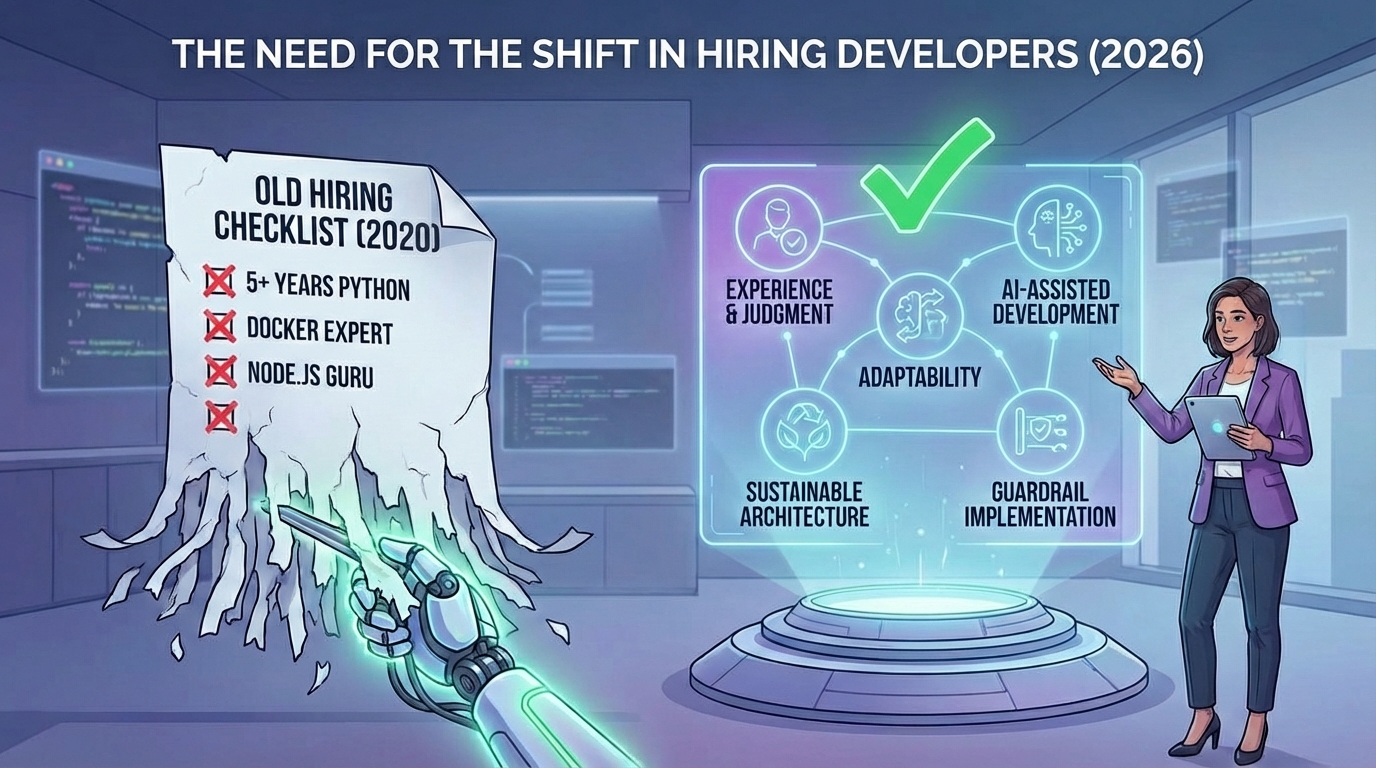
Generated by Google AI Studio
Over the past six months, I've reviewed hundreds of job specifications for developers and software architects. Almost all follow the same pattern: long wishlists of skills, years of experience in every technology, checklists that feel like they were written for 2020.
I think we're overdue for a different approach.
With AI-assisted development, the landscape has shifted. You don't necessarily need someone who ticks every box on your wishlist. Those candidates are rare, expensive, and hard to retain anyway.
Here's what I believe matters more now: the ability to leverage AI to build software sustainably—using practices like spec-driven development, test-driven development, architecture-as-code, and robust CI/CD pipelines. The core skill isn't writing code anymore. It's guiding the process, setting up guardrails, and ensuring quality, security, and maintainability.
I'll be honest: I'm not an expert in Python, Docker, GraphQL, Node.js, React, Terraform, or CI/CD, so don't give me a deep technical interview on any of these! But I use them all to great effect to build production-grade software. I know enough to separate good from bad, to read code, spot technical debt, and steer AI agents toward best practices—without needing 5+ years of experience in each technology.
To recruiters and hiring managers: consider looking for people with proven experience in development, architecture, and product ownership who are still hands-on, still learning, and know how to use AI tooling effectively. That combination is powerful—the technical judgment, the pattern recognition, the understanding of what makes software maintainable, plus the ability to define product vision, shape user experience, set priorities, and know when an MVP is good enough to ship. That may be more valuable than expertise in a specific framework that will be outdated in a few years.
And to recruiters specifically: I understand you're given job specs by hiring companies. But part of your value is helping hiring managers see what they might be missing. The world has changed. There may be smarter hiring choices that deliver more speed, more quality—and also inject new thinking, a new way of doing things, into their teams.
This isn't just about me. There are experienced developers and architects being overlooked because they don't fit the old mold. They're not obsolete. Their ability to think critically, solve complex problems, and guide teams through modern development challenges is arguably more relevant than ever.
Just as an example
Despite not being an expert in many of the underlying technologies, I was able to deliver almost 40 weeks of work in just over 2 weeks. No technical debt. Fully automated documentation and architecture diagrams. Everything developed using strict spec-driven development and test-driven development, Architecture as Code, enterprise-grade security, security audits, automated refactoring, and a complete CI/CD pipeline with 10 types of automated checks—testing code quality, security, fitness functions checking for architectural drift, dependency analysis, and more.
How many developers or software architects cover this full quality spectrum in so little time?
And yet, I'm hesitant to apply for many roles because I don't meet the "must have" skills or the expected years of experience in specific technologies. That disconnect is exactly what I'm talking about.
What I'd encourage you to look for
People who combine:
- Proven experience in development and architecture—and who are still hands-on, still learning
- Product vision: the ability to define what to build, for whom, and why
- Mastery of AI tooling to accelerate delivery without sacrificing quality
- A focus on automated guardrails, documentation, and architecture diagrams
- Fluency in proven practices: spec-driven development and test-driven development
- Architecture as code—a newer but essential discipline for maintaining architectural integrity
- An understanding of domain-driven, maintainable architecture
- The willingness (and ability) to mentor and uplift existing teams—sharing both their experience and their AI expertise to help others navigate this new way of working.
The future of development isn't about memorizing syntax or accumulating years in specific technologies. It's about experience, judgment, and the ability to harness new tools effectively.
The best teams will be built on adaptability, not checklists.
#Hiring #TalentAcquisition #AIAssistedDevelopment #SoftwareArchitecture #FutureOfWork #DevOps #TechCareers