Everyone Is Falling Behind. Even the People Giving the Advice.
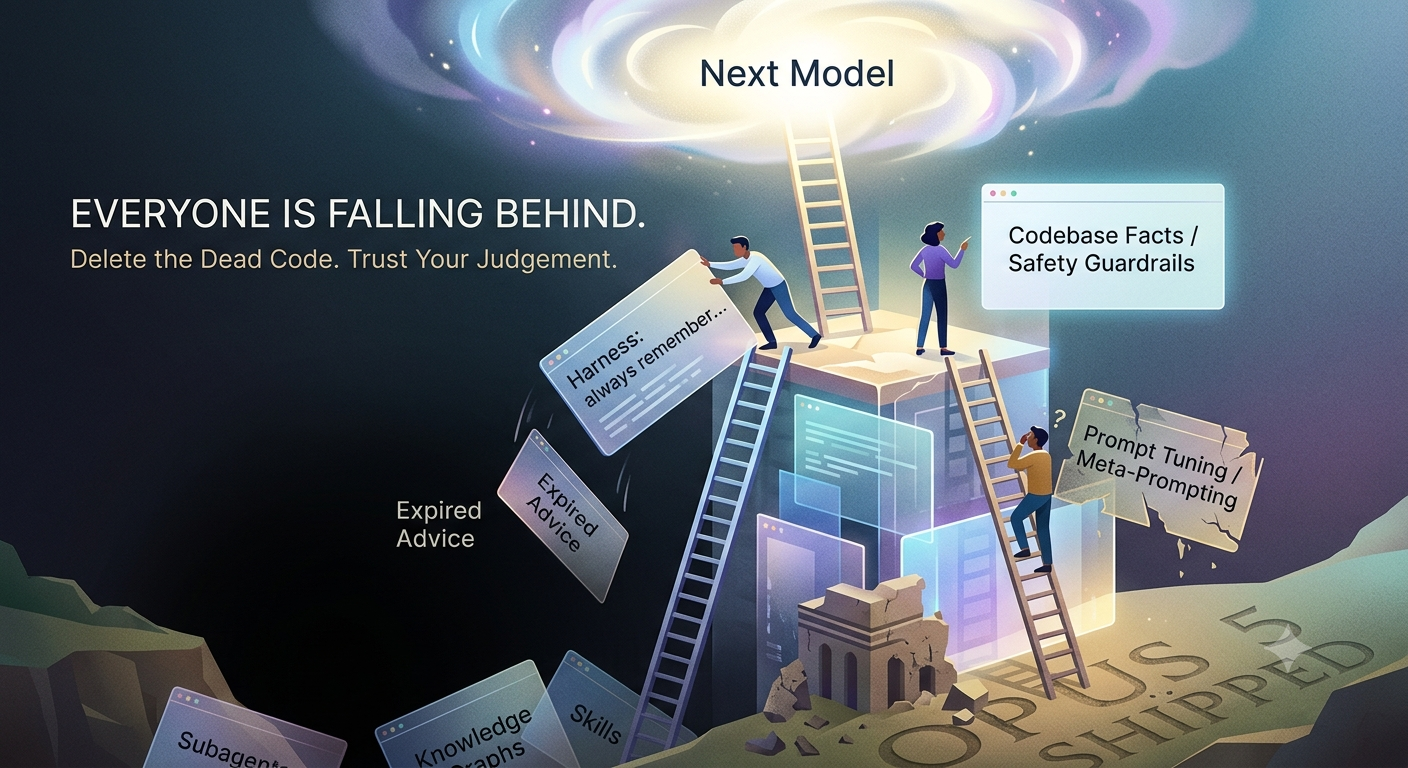
Boris Cherny, who built Claude Code and still runs it, sat on a Y Combinator Startup School stage one day after Opus 5 shipped and told a room of founders to delete their files. Delete your skills. Delete your hooks. Run it bare and see what happens.
He also told them not to listen to LinkedIn influencers. So, ironically, here is a LinkedIn article about it.
The part worth admitting out loud
I use coding agents professionally, most days. I read the changelogs, watch the talks and hours of YouTube videos, install new tools, write about this, present about this. Staying current is literally part of my job.
I still can't keep up.
I looked at my own Cursor and Codex harness recently. It's accumulated loads of unused or obsolete skills and layer after layer of "always remember..." instructions. Some still help. Some are just burning context because the models have already outgrown the problem they were written for.
And if I can't keep up, what are we asking of the 200-engineer department that only got approval to use coding agents last quarter and has its first compliance review in spring?
Nobody sold us a lie
Almost all of it was good advice at the time.
Learn prompting. No, prompting is table stakes, learn meta-prompting. Actually it's context engineering now. Put repeated work in slash commands. No, use subagents. Those are getting heavy, package them as skills. Stop writing instructions, write goals. Stop writing goals, write loops. Add a knowledge graph.
And now: delete most of it.
(Anyone building retrieval systems climbed almost exactly the same ladder.)
Every rung cost a weekend to learn and another month before it became second nature. Then the next model arrived.
I don't regret learning any of it. I do regret pretending any of it was permanent.
Why it keeps expiring
I think the problem is actually simpler than "AI moves fast."
We treated model workarounds as if they were software engineering.
The evidence is in the talk itself. Anthropic cut more than 80% of the Claude Code system prompt for Opus 5 and found the model no longer needed the rest. Most of those instructions weren't bad instructions. They were fixing behaviour the new model simply doesn't have anymore.
That's the deal early adopters signed without really realising it. You spend evenings building and maintaining the perfect harness, and six months later the model no longer needs half of it. Worth remembering before you invest another weekend writing a 400-line rulebook.
Delete for which model, though?
There's one catch.
That advice was for Opus 5. Cherny's team tunes one harness for one model. They have evals. They have engineers whose job is to measure this stuff.
Most of us don't work like that. You're using Copilot, Cursor or Codex. Your company routes work to different models depending on cost or availability. Sometimes your editor quietly changes models underneath you.
So you delete forty lines because today's best model no longer needs them and... did things get better? Or did the model change?
Two things changed. Only one of them was yours.
That's why I think it's useful to split your harness into three parts.
- Things about your codebase. Build commands, conventions, architecture, naming. Every model needs these.
- Reusable workflows. Skills and repeatable processes that capture how your team works. These can improve over time, just like any internal tooling.
- Model workarounds. The "always remember..." instructions, reminders, and fixes for model-specific behaviour. Date them. Write down which model they were written for.
Archive them before deleting them. Try running without them for a while. If you find yourself adding one back, it probably still earns its place.
What actually holds still
The thing that doesn't expire isn't your AGENTS.md or your Cursor rules.
It's your judgement. You get better at breaking work into smaller pieces. Better at spotting when an AI is confidently making things up. Better at knowing when to trust it and when to stop it. That survives every model release.
The rest is mostly configuration. Treat your harness like a codebase: delete dead code and obsolete skills, keep the architecture.
And don't listen to LinkedIn influencers.
This one included.
Related reading
- AI Is an Accelerator. Be Careful What You Accelerate! — why scaling AI without data quality and validation also scales risk
- Supercharge Your Workflow: Mastering Cursor and the Art of "Vibe Coding" — practical Cursor harness and workflow patterns
- AI-Assisted Development services — how AI-chitect helps teams adopt coding agents with architecture and governance